
A few years ago, when my son was around 3, the local shopping center was having a Fall Field Day, with games, food and all kinds of free entertainment for the kids. We headed down for an afternoon of cheap, suburban family fun.
One of the kiosks there was offering on-the-spot “portaits”. So, my wife and I excitedly sat Noah down across from the guy with the easel… and waited.
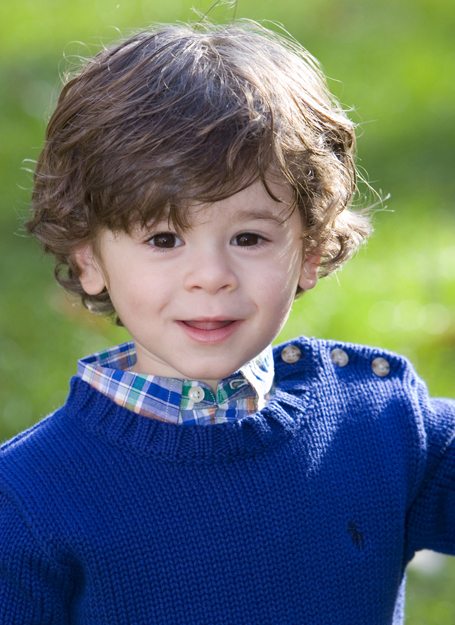
Now, to help explain what I’m about to show you, here’s a photo of my son from around that time:
(Beautiful, I know).
Now, imagine our surprise, when a minute or so later, the artist turned around his easel, and showed us THIS.

(Note: My apologies if the creator of this piece is currently reading, but the phrase “go back to the drawing board”, fits like a glove here).
If, Heaven forbid, my son had been missing, and I had given this portrait to those searching for him, I’m convinced they would have returned with a Liza Minelli impersonator.
Noah, horrified at his “likeness”, began to cry. Comforting him I said, “Son, don’t worry, if you actually looked like that, I would cry myself!”
OK, so to be fair, this portrait was never meant to accurately capture my son’s likeness. It was not a realistic representation of him. This was but a caricature; an oversimplified, exaggerated cartoon, meant to, in a few seconds, describe something vague about him, but it could never do him justice.
Sadly, I see this happening to people every day on message boards and talk shows and status updates and photo-shares; not with Sharpie markers and paintbrushes, but with laptops and smart phones.
These comic book portraits all begin with phrases like:
“All you Liberals…”
“All you Conservatives…”
“You Christians…”
“You Atheists…”
“You people on the Left…”
“You people on the Right…”
And these words are always followed by the most broadly-drawn, inaccurate, vague generalizations one could ever imagine.
This is because we are a profoundly lazy people.
When it comes to our public discussions on virtually any topic, whether it be war or taxes or gay rights or guns or health care or religion, we are not willing to take the time to really flesh out our adversaries; to capture their complexities correctly. We want a quick, easy, exaggerated sketch that we can slap up into our conversations, and continue on with our monologues.
It hardly matters whether we are accurately depicting them or not. In fact, if we keep people simplified, if we caricature-ize them, it is much easier to win our arguments, as they can be as one-dimensional and silly as we desire.
We love to create Cartoon People.
Though human beings are each unique, once-in-history creations, made in the unbelievably complex image of their Creator, we’d rather lump them all together into cheap, simple boxes.
And in heat of the battle, in the middle of the arguing and debating, it never occurs to us that this character-renovation is simply ridiculous. (Think for a moment, when a sentence beginning with the words “All you _______’s…”, ever did anything to create respectful dialogue or build relationship).
No, these generalizations are always conversation-stoppers. They’re a signal to the recipients to dig-in, load-up and fire back. (This is how most of us react when unfairly attacked).
Soon you will, if you are at all connected to this earthly human existence, engage in important conversations, about stuff that means something, with people who matter.
And during these discussions, as you sit across from someone, whether at a kitchen table or a computer screen, be careful not to oversimplify them.
Take some time to listen, and to clearly see each of them, in all their beautifully diverse individuality.
Discard the easy labels for those you disagree with.
Stop turning masterpieces into cartoons.


